Σάββατο, 10 Οκτωβρίου 2009

Fast forward

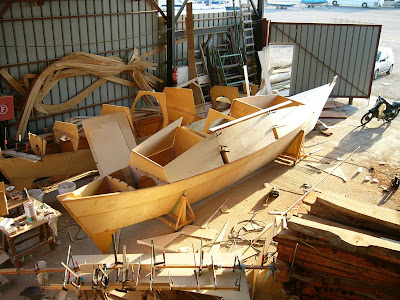
It has been a while since my last post, but I am happy to say that construction is in fast forward since I have moved the boat to Vasiliadis boatyard! In the last month there was progress I admit it would take me another year to make!
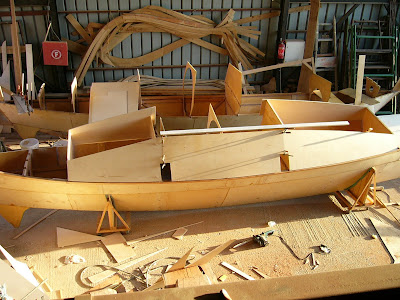
As I had already cut the lower hullside panels and the bulkheads for the port hull as well, they were easily coated with epoxy, longitudinal stringers, bunk and deck bearers were glued and port hull was assembled within two weeks. There were some problems with making the keel and bulkhead fillets as the yard's shed is open all around. That means it is exposed to outside temperatures, which at this time of the year were between 27-35C, too hot to work with epoxy in narrow spaces (it was steaming like hot Greek coffee!). As a result we left that task to complete later and went back in the completion of glass reinforcing the starboard keel fillets, cutting the floors and rear bunks of starboard hull, cutting and coating the upper hullside panels for both hulls and many other small tasks.
However, the problem now with all that progress on the project is that I have to make a lot of decisions in a short time! Things like water supply, wiring, configuration of the enclosed- in my Tiki 31- central cockpits, beam throughs, deck configuration etc, were supposed to occupy my mind within the next couple of years. Now I have to decide on all these matters in a few weeks! ( I will post on these decisions later)
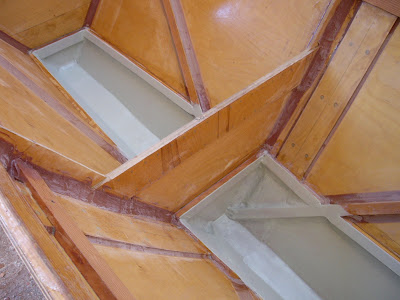
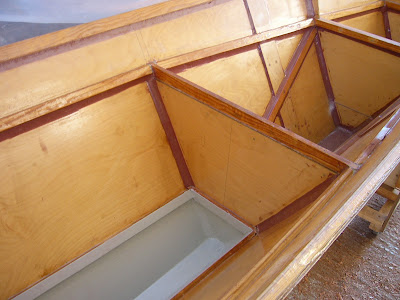
Hopefully in the next few weeks we will manage to put the final coats of epoxy to the bilges and the space under the bunks of starboard hull, prime and paint them and glue the floors, bunks and upper hullsides. Keel, stem and stern fillets of port hull will be completed at the same time.


Starboard lower hullside panels coated with epoxy


At last a Wharram catamaran!


Galley floors


Rear bunk


Ex open central cockpit, now enclosed galley..

Stem fillets

Κυριακή, 16 Αυγούστου 2009

Change of course

Since the beginning of this project, almost three years ago, a lot of things changed in my life. I got married, my daughter was born and hopefully, in a few days my wife will give birth to our son.
As far as the boat is concerned, all these changes ment a considerable reduction in my free time, thus in building time. The distance of the building spot from my house made things even more difficult, resulting in almost zero progress during the last year.
I started building the crossbeams in a friends workshop near my house and for the last three months made an effort to find an inexpensive warehouse closeby to accommodate the hulls. I even traveled to Turkey to see an old Tangaroa which was for sale (..a long story) in an attempt to enter the world of Wharram sailors earlier. It was hopeless! I realised that my only chance to be sailing next summer was to have my boat finished and the only way to do so was by acquiring professional help! It wouldn't be cheap but it would certainly be a lot faster then building alone.
Since my decision was made it was only a matter of finding the appropriate people and moving the unfinished hull and the rest of the material to the boats new home. The appropriate people were Vassiliadis bros, with a long history in boatbuilding, mostly traditional Greek vessels (Traehandere), but also experienced in plywood-epoxy construction methods. They are located in Heraclion city harbour, which is only 10' drive from my house. This makes an almost daily visit possible to attend to a new stage of the construction, to short out some details or complete myself many of the different tasks remaining until the realisation of my Tiki 31.
Moving the hull was another thing...The narrow space outside the garage, where I was building until now, made the approach of a large crane impossible. The only way to take the hull out of there was by man power! A few friends came over and helped me roll the hull on small wheels out of the garage and down the steep and narrow alley of my parents' cottage to the main road where the crane lifted it. Fortunatelly the whole process went by smoothly and a few hours later the hull was lowered in it's new building shed almost thirty kilometers away!


Κυριακή, 03 Μαΐου 2009

Crossbeam construction

Crossbeams are at last under construction. This part of the building process has hardly any difficulties except for the fact that the ply crossbeam web consists of nine pieces on which fourteen hardwood pieces must be glued (more if they are scarf joined). As a result every crossbeam involves a serious amount of work and demands a serious amount of clamps! Fortunately, in the carpenter's workshop that I am assembling the crossbeams, clamps are not a problem! 


Σάββατο, 21 Μαρτίου 2009

Masts and crossbeams

   It has been a while since I last updated this blog. Although I had a lot of other obligations during this period, I didn't neglect the boat at all! As the weather for the last couple of months in Crete was too cold for gluing, glassing, filleting etc, I decided to chanel other time consuming parts of the project such as the masts and the crossbeams. Their construction is straight forward but they consist of numerous components-ply webs, lots of softwood and hardwood parts-that take long to be cut and glued together, a fact that pointed out the significance of a workshop as close to my appartment as possible.
     As mentioned in previous posts, I was in search of such a workshop, so as to be able to spent every free hour on the project. A few days ago, a friend and proffesional carpenter agreed to let me construct a bench in one side of his workshop to glue up the masts and crossbeams. Furthermore, his stuff was willing to help me cut and shape all the wood parts of the assembly.
     The firt thing I had to do was find the appropriate wood needed. This was not easy as Douglas fir or Oregon pine (as is more familiar in Greece), the kind of wood specified for the job, is not very popular among house and furniture constructors lately. As a result wood suppliers in Crete don't import it any more. As if this was not enough, the ammount I needed was about 1,5 m3 and it should be first class. I had to buy from three different suppliers to find the quantity required and discard some when cutting and planing as unsuitable ( from lower quality). Total cost: 1800€ plus some 500€ for more epoxy and materials for the bench...a lot of money for pine...
    The good news is that with the Douglas fir for the masts and crossbeams I have almost bought all the material needed to complete the boat except for some more epoxy and glass cloth. In a later post more economical aspects will be mentioned as I think every future builder of such a boat would be interested in having a realistic estimation of the cost.
     In the photos below the first steps in organizing the construction of the two masts and four crossbeams are shown. Notice the 6m long cleargrained Douglas fir pieces I managed to find in a wood suppliers warehouse (unsought for two years..) and the beautiful Wharram  mast bases that I cut from a piece of oak I found in my friends workshop. Mast crane is from Iroko.  


6m long Douglas fir pieces. Not easy to handle but will save me a lot of scarf joining!


Cutting the wood

Only half the ammount required!


The two part gluing bench. A third part will be added for gluing the masts


Parts of the mast crane and the two oak bases

Τρίτη, 02 Δεκεμβρίου 2008

Heat!

Boatbuilding must progress during the oncoming winter. This requires heat!
Although temperature in Crete is still 15-20C I started experimenting in finding a way to heat the garage.
Aris, a good friend and fan of the project, kindly donated the kerozene heater seen in the pictures below. It is very economic and produces heat constantly, without a thermostat, which makes it ideal for large not fully enclosed spaces. When I tested it though I realized it was small for my boatbuilding shed which has no insulation and part of which is enclosed by iron plates (thus completely exposed to externel temperature changes). Nevertheless, it managed to maintain a stable inside 19C, while the outside temperature fell by nightfall to a prohibiting for epoxy work 15-16C (unfortunatelly the West System 205 hardener which is specified for colder climates is not imported in Greece!?).
As a result I think I will buy an identical heater and with both in use I will be able to use epoxy even during the coldest days of Cretan winter.
During the heaters test I managed to apply the first coat of epoxy on the underside surface of the plywood sheets of the forward bunk and floor and complete some of the keel and bulkhead fillet sanding. As soon as I finish with the glass reinforcement of the keel in this forward compartment I will paint it white before the final installation of the floor and bunk.


Heater in action!


Forward bunk and floor plywood parts cut
and epoxy coated on one side


Τρίτη, 18 Νοεμβρίου 2008

Sanding land!

Although I rashed to cut the forward bank last week there is a lot of work to be done before its installation. Most of it is sanding and fairing!
A lot of people underestimate sanding as a basic part of these kind of projects. I think sanding is the finishing touch that will help reveal and then correct all the imperfections. It is what makes the difference between the smooth, elegant finish of a craftsman's work and an amateur construction. Keeping this in mind I removed the forward bank and started sanding the keel and bulkhead fillets in preparation for glassing the inside area of the keel with two layers of 6oz glass cloth as a reenforsment. I also removed with a dremel tool most of the fillets of bulkhead No4 - which were the first I made and looked like a real mess - and made new, before applying the glass cloth in this part of the keel.
When the new fillets were curred and sanded the area that was about to be glassed was taped all around at its boundaries (Scott William's technique). The glass cloth was cut and put in place and wetted out with a combination of brushing and using a squeege to remove excess epoxy. With epoxy in a tacky state the glass cloth was cut with a razor at the edge of the tape which was then removed leaving a clear margin between the glassed area and epoxy coated plywood.


Sanding...


Bulkhead's No4 new fillets!


Glassing the keel


Πέμπτη, 06 Νοεμβρίου 2008

Master bedroom...

I haven't made considerable headway with the project lately as I was "up to the throat", as Greek people say, with deadlines and comitments, both at work and with familly matters.
As a result I didn't feel much enthusiasm as I was driving to the boatbuilding shed last afternoon. To my disappointment my free time has decreased a lot lately and sometimes boatbuilding seems to be one of my last priorities, leaving me way out of my timetable.
I desperately needed some encouragment, so, instead of following the right sequence (thus sanding the fillets and the inside hull area below the floor and bunk level) , I desided to measure and cut the forward bunk.
The trick had instant results and worked as a visual injection of moral! It was the first time that I stepped into the hull, sat on the bunk and imagined the space of the forward cabin...That was it! I was dreaming again!