Σάββατο 8 Μαΐου 2010

Cretan Wharram....fleet!

I haven't realy been close to many Wharrams. I can merely recall a Narai I saw from a distance some years ago in the Ionian sea, Pahi 42 "Bananas" in Agios Nicolaos marina in Crete and a Pahi 63 along with a couple of Tangaroas in Fetyie, Turkey last summer. I have never sailed in a Wharram. Haven't even seen one sailing, except from some short videos in YouTube. It seems like these boats are not very common in the southeast part of the Mediterranean.

All these didn't bother me though all these years that I was building my Tiki 31. I had some doubts, but my passion for Wharrams was great and the few things I was reading every now and then in other builders' blogs, along with some photos on the net, were enough to keep me going. But as another summer is approaching and the launching of my boat is still uncertain, my doubts seem to have surmounted my enthusiasm for the first time! Why was I so attracted by these boats? Which are their sailing abilities and who made me think they are suitable for the weather and sea conditions of the south Agean. If only I could gain some experience...

Then, an amazing thing happened! I saw an add for a Tiki 21 which was for sale in....Crete!

I couldn't believe there was another Wharram so close to me all this time! I spoke to my friend Aris who, by helping me with my boat every now and then, had developed the same passion for these unique vessels. He emmediately agreed to come with me and see the boat and was willing to buy it for the right price. I, on the other hand, was ready to do all the repair work with him, as it was a unique opportunity to at last sail a Wharram in local conditions and acquire valuable knowledge which I could use in finishing, fitting and sailing my own Wharram cat!

It turned out that the boat was in good condition and the previous owner was an English gentleman who just wished to see it go to the right person. Someone who could appreciate it's values and care to see it sailing again after five years of only occasional use. That was it! Aris was the new happy owner and the end of the week found us taking the boat by trailer to Heraclion where we will make the necessary repairs so as to hopefully launch her by the end of May.

One thing is certain though.....Wharram cats are not so scarce in cretan waters any more!

Tiki 21 on her trailer

Only the absolutelly necessary repair work will be done this year. Mostly painting that is.

Aris is the new happy owner and Wharram enthusiast!

Τετάρτη 28 Απριλίου 2010

Wings for migration!

New sails from Jeckells arrived last week, along with a Facnor reefing system for the jib. The sails have a beautiful tan color, which I think will match nicely with the off white or the light beige color I intend to paint the hulls. My first impression on their quality is positive, but I am certainly looking forward to zipping them up the masts and testing their performance at sea!
The reefing system looks robust and was accompanied by a detailed manual, as well as all the extra bits needed for the installation.
In the mean time the crossbeams were finished and are now waiting for the last fairing process, before being primed and painted. The reason that I haven't done this yet, is because I haven't desided if I will cover them with glass, for extra strength and maintenance, or I will just give them four coats of clear epoxy, before primming them like Wharram's plans recommend. I have read controvercial things about glassing the crossbeams, most of them concerning their loss of elasticity in contraction and expansion due to temperature changes, which eventualy leads to cracking. I think I have some more time to think about it...
Two extra oval section crossbeams are also being constructed this week. They will be lashed on the stem and stern posts, supporting a forward and a rear netting. These will contribute a lot to the usable space on decks.
Things are moving along again, but, despite my enthusiasm, I have to wait until the end of May, which marks the end of the constuction of the large traditional boat in the boatyard and the beginning of the last stage of the building of my catamaran. If I am lucky enough and the people from the yard work hard, I could foresee a launch by the end of the summer. If I am not....

The drum of the Facnor reefing system

Wings for my boat!

The crossbeams waiting for their last fairing process

Παρασκευή 26 Μαρτίου 2010

Traditional boatbuilding

The productive and full of enthusiasm days of September, October and November gave way to the infertile boatbuilding days of this years’ winter. People from the boatyard undertook a major project: the building of a 60ft traditional vessel (karavoskaro), which will be used as a touristic coastal cruiser in Crete. Their deadline is by the end of May 2010. The wooden framework of the Golayath took over all the free space in the boatyard so there was no longer space for my tiny catamaran. We had to move it yet for another time. The two hulls were lifted to a balcony high under the yard’s roof, whose floor was used for lofting. I could now continue to complete some small tasks like painting the interior of the lower hulls and installing the floors and banks, while supervising from above the progress in the construction of the large kayki.

The completion of a traditional wooden boat of this size in only seven months is an operation that required all the men power the yard had available. Forty (40…!!?!) tons of hardwood logs (Iroco and eucalyptus) were cut and about 60% of that was used for the keel, stem and sternposts and for the rest of the framework. Every single rib of the boat needed a clark to lift it and hold it in place until it was glued-bolted. The more I watched the progress on this vessel the more I was impressed by the massive construction, but, also, the more the different approach of Wharram’s catamarans to the sea made sense to me. These lightweight crafts, though basically wooden, required only a fraction of the wood needed to build a wooden monohull of the same length (even if the monohull was constructed in the same wood-epoxy method) and based their seaworthiness on their ability to follow the motion of the waves rather than force their way through them. Lower aspect rigs with less sail area are needed to take them sailing in higher speed and only a small outboard is usually enough to maneuver a 30-40 ft long boat in and out of the harbor or motor with low gas consumption for miles and miles. No wonder why this combination of seaworthiness and economy in construction-maintenance has made these vessels so popular.

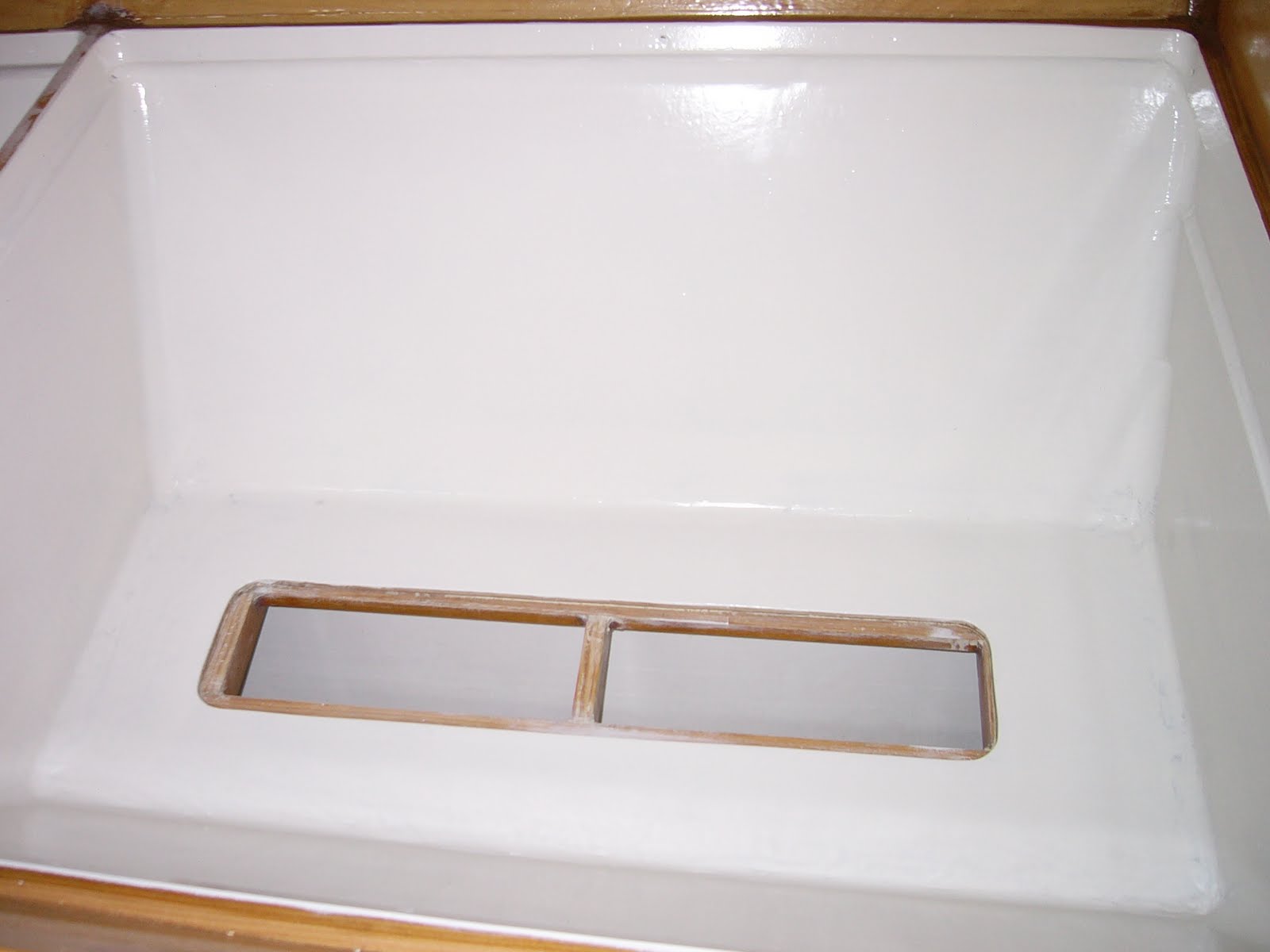
To my disappointment and also to disappoint the last few (bored to death) readers of this blog, only little progress was achieved in the hull construction during the last couple of months (..sorry Hector!). I managed to cut the banks and floors of starboard hull, reinforce them with pitch pine frames underneath and coat them with epoxy. The area under the floors was sanded and coated with two coats of clear epoxy, then three more layers of Hempels’ Light (epoxy) Primer was applied, before the floors were glued in place. No top paint was used in these areas since they will never be exposed to the sun light and Hempels’ Light Primer is said to be very durable to water and other liquid material that may fill the bilges. The areas under the banks as well as the rest of the inside of the cabins are being painted white with a satin finish, using Hempels’ Multicoat (three layers on top of a total of three coats of clear epoxy).

Meanwhile there was encouraging progress in the construction of the crossbeams which are now finished except for a few triangular section pieces. I am very pleased with the result as first quality Oregon pine in full lengths was used and the crossbeams are relatively light, though very strong! I haven’t yet decided if I will cover them with glass cloth before I paint them as I have heard controversial comments on this technique and Wharram doesn’t recommend it in the plans. Two more beams will be constructed next week to support the fore and after netting, but these will be hollow, round or oval section beams with the same construction as the masts (no plywood frame). The masts themselves will be constructed by the end of April along with the gaffs, tillers and various other small parts as it is my decision to finish with all these time consuming small tasks before the end of May. Then, as soon as the yard staff is available again, I will be able to focus entirely on the finishing of the hulls and the assembly of the boat before the end of the oncoming summer.


Only a third of the hardwood used for the framework!!

Constuction of the keel, stem and sternposts


Ribs in place (stern view)

Ribs (bow view)

Tiki before being lifted to the lofting balcony

Sanding and applying the last coats of clear epoxy on the inside of the lower hulls


Floors and banks reinforced and coated with epoxy before installation


Floor installation


Painting the area under the banks


Crossbeams almost finished!


Σάββατο 10 Οκτωβρίου 2009

Fast forward

It has been a while since my last post, but I am happy to say that construction is in fast forward since I have moved the boat to Vasiliadis boatyard! In the last month there was progress I admit it would take me another year to make!
As I had already cut the lower hullside panels and the bulkheads for the port hull as well, they were easily coated with epoxy, longitudinal stringers, bunk and deck bearers were glued and port hull was assembled within two weeks. There were some problems with making the keel and bulkhead fillets as the yard's shed is open all around. That means it is exposed to outside temperatures, which at this time of the year were between 27-35C, too hot to work with epoxy in narrow spaces (it was steaming like hot Greek coffee!). As a result we left that task to complete later and went back in the completion of glass reinforcing the starboard keel fillets, cutting the floors and rear bunks of starboard hull, cutting and coating the upper hullside panels for both hulls and many other small tasks.
However, the problem now with all that progress on the project is that I have to make a lot of decisions in a short time! Things like water supply, wiring, configuration of the enclosed- in my Tiki 31- central cockpits, beam throughs, deck configuration etc, were supposed to occupy my mind within the next couple of years. Now I have to decide on all these matters in a few weeks! ( I will post on these decisions later)
Hopefully in the next few weeks we will manage to put the final coats of epoxy to the bilges and the space under the bunks of starboard hull, prime and paint them and glue the floors, bunks and upper hullsides. Keel, stem and stern fillets of port hull will be completed at the same time.


Starboard lower hullside panels coated with epoxy


At last a Wharram catamaran!


Galley floors


Rear bunk


Ex open central cockpit, now enclosed galley..

Stem fillets